
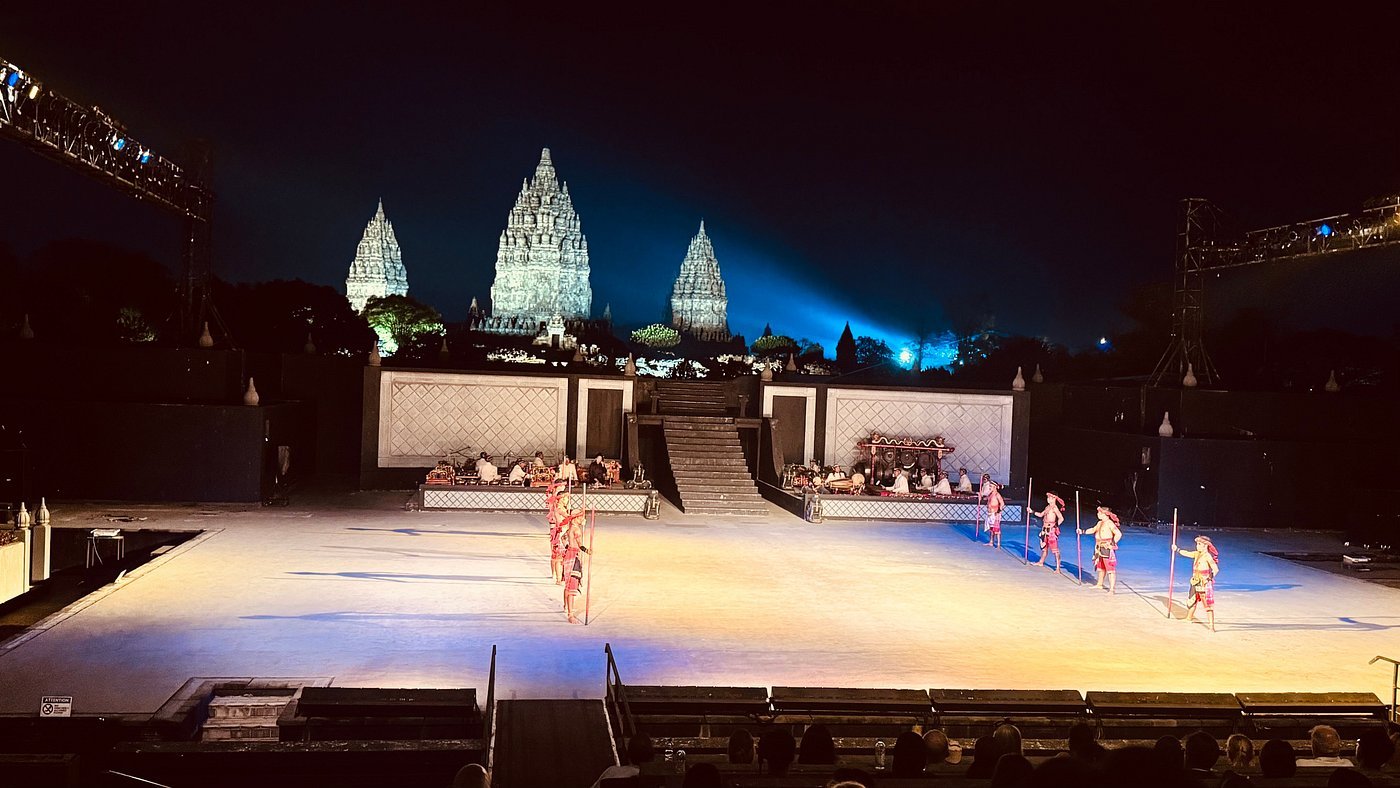
For many foreign visitors, a trip to Yogyakarta does not feel complete until they have spent one evening sitting under the open sky, watching an ancient story unfold in front of a temple that has stood for centuries. Sendratari Ramayana Prambanan has become that kind of experience. It is not simply another cultural show on a tourist itinerary. It is a meeting point between epic literature, human movement, and the glowing silhouette of Candi Prambanan after dark.
What makes the performance stand out is not a lavish modern stage. It is the restraint and depth behind every movement. More than 200 dancers and musicians take part in each staging, telling the story of Rama and Sinta without a single line of dialogue. Gestures, gamelan melodies, and vividly coloured costumes carry the narrative across language barriers. The format has been kept alive since the performance was first staged in 1961, and for good reason: its authenticity speaks louder than any spoken explanation.
The audience numbers suggest that this approach still works. During the 2025 Lebaran holiday period, Ramayana Ballet Prambanan drew 3,617 visitors in six days, making it the strongest cultural attraction in the Taman Wisata Candi area. Across 2024, attendance passed 121,000, a sharp rise from previous years. Those figures are not accidental. They reflect steady confidence in a production managed consistently by the Theatre and Performance Unit of PT Taman Wisata Candi.
For international travellers, part of the appeal lies in something they cannot easily find at home. Reviews on global travel platforms repeatedly point to the setting as the detail that makes the night hard to forget. “The setting was stunning and the performances were amazing,” wrote an Australian visitor who attended the August 2026 show. Another reviewer, Kathy_T, called the performance “spectacular” and praised the ticket-booking process that helped her secure a good seat. On TripAdvisor, the production holds a 4.5 rating from 790 reviews, with most reviewers describing it as a cultural experience worth trying at least once.
A Stage That Borrows the Temple
Ramayana Ballet Prambanan differs from other dance productions because the landscape does much of the storytelling. From May to October, the performance takes place at the Open Air Theatre, with Candi Prambanan serving as the immediate backdrop. When the stage lights sweep across the ninth-century stone walls, the audience is not looking at a replica. They are watching the temple itself become part of the story. From November to April, the show moves to the indoor Trimurti Hall to avoid the rainy season, but the essence of the performance remains intact.
The schedule and ticket prices are designed to stay accessible without sacrificing quality. For the 2026 outdoor performances, Class 2 tickets are priced at around Rp165,000, Class 1 at around Rp220,000 to Rp275,000 depending on the day, while VIP seats reach Rp495,000 to Rp550,000 on weekends. A VIP ticket is not just a numbered seat. It includes a soft drink and a traditional snack, a small detail that makes the evening feel more personal. The management advises visitors to arrive 30 to 45 minutes early for ticket validation and to find a comfortable seat, especially families travelling with children.
The performance also reflects how cultural tourism in Yogyakarta has recovered and grown. Statistics Indonesia’s DIY office recorded 8,689 foreign tourist visits through Yogyakarta International Airport in April 2026, up 21.78 percent from April 2025. Cumulatively, January to April 2026 recorded 29,394 visits, an increase of 27.11 percent. Malaysia, Singapore, and China were the three largest source markets, while Europe contributed 1,581 visits in April 2026 alone. These numbers help explain why a production like Ramayana Ballet remains relevant. It acts as a cultural anchor, encouraging travellers to stay longer and spend more in Yogyakarta.
Numbers Tell One Story, Memories Tell Another
Data, however, is only one side of the coin. What happens on the ground is often more revealing. A Belgian tourist who watched the Wayang Jogja Night Carnival 2026 described the atmosphere of Yogyakarta’s cultural events as “magic” and “extraordinary,” a sentiment often directed at the Ramayana performance in Prambanan as well. Other reviews say the production draws audiences “into the storyline” through lighting, gamelan, and intense expressions from the dancers. That is something statistics cannot capture: the sense of wonder that makes someone sit quietly for 90 minutes, carried by a tale that is thousands of years old.
For organisers and tourism players, consistency is the key. A performance that has run for more than six decades did not survive by chance. It is maintained through risk management, stage adaptation, and, most importantly, respect for the story itself. When foreign visitors leave with memories of a night at Prambanan, they take home more than souvenirs. They carry the name of Yogyakarta as a city that knows how to keep the past alive before people’s eyes.
If you are planning a trip to Jogja and want to feel the cultural pulse that has won so many foreign travellers over, start with Prambanan. There, the temple, the dance, and the night come together in an experience that is hard to leave behind.


